


Songwriting
THE ART OF SONGWRITING
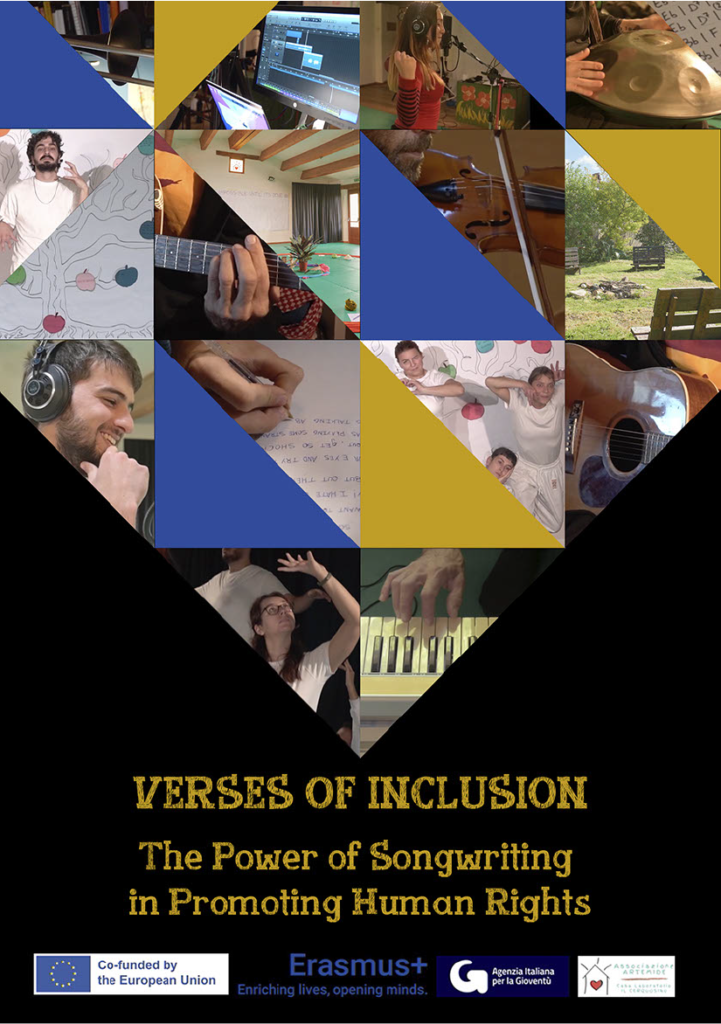
Songwriting is not just about creating a song, but a powerful tool for promoting sharing and belonging, as well as for developing themes linked to human rights, resilience, immigration, social oppression, inclusion and exclusion. Through an educational path that includes an introduction to the concepts of diversity and inclusion, the exploration of thematic songs and the identification of meaningful topics, participants develop writing skills to express their personal experiences. Creating songs fosters both individual and collective work and unfolds through many different stages, useful for strengthening participants’ self-confidence and their sense of empowerment in being able to create something together.
"Even if I knew the
world would fall apart tomorrow I would still want to plant my apple tree."
(Martin Luther King)
METHODOLOGY
The birth of a song within each Erasmus+ project activity is part of a pathway built through experiential workshops and theatre-based activities. The song represents the endpoint of a journey made up of shared experiences, learning, listening and collective research. In this context, the phrase that gives the project its title, “Even if the world…”, serves as the mainpoint of reference for the pathway. The methodology used to reach the brainstorming stage and start creative writing is based on Augusto Boal’s Theatre of the Oppressed, inspired by Paulo Freire’s “Pedagogy of the Oppressed”, which emphasises the importance of authentic dialogue and conscientisation.In particular, image theatre was used, which explores different perspectives on the premise that “the whole body thinks”, understanding the human being as a reciprocal interaction between mind, body and emotions. The “theatre statues” are one of Boal’s key techniques, in which participantscreate poses or bodily images that embody specific concepts, emotions or situations. These statues, both static and dynamic, are used to explore power dynamics, interpersonal relationships and social issues. Through this experiential process, participants are encouraged to reflect on what they have represented, giving rise to words, concepts and content that emerge from each action carried out in the theatre work. This material, rich in meaning, is then developed through writing, allowing the creation of songs that reflect the participants’ experiences and emotions.
BRAINSTORMING
To begin a creative writing process focused on resilience, human rights and the fight against discrimination, brainstorming is used as the initial tool. This process begins with the use of the body and involves participants in an active immersion in the topic. Bodies move freely, improvising walking styles, speeds, levels and postures. This physical expression fosters a deeper connection with the theme being explored, allowing each participant to better explore and understand their own emotions and reactions.While moving, they reflect on the theme of the project and on their own experiences, speaking their thoughts aloud and sharing characteristics and associations of ideas that emerge, also through image theatre, staging the representation of their own statues. This practice not only stimulates creativity, but also encourages open and authentic dialogue with oneself. Once this phase of physical exploration is complete, each participant sits down in front of a blank sheet of paper and begins writing their reflections. Here, they have the chance to deepen the meaning and concepts that emerged during the brainstorming, composing structured sentences or simply listing key words. This step allows ideas to be consolidated and prepares the ground for the creative writing that follows, making the process richer and more meaningful.
CREATIVE WRITING
After the initial brainstorming phase, the work moves into a moment of intention and synthesis, in which the concept is explored and defined with greater awareness. At this point, each participant is invited to express their message through rhymes, assonance, similes and metaphors, creating two “musical” phrases capable of conveying the intention and emotion of the content.The process then moves from individual to collective: participants split intogroups and receive, in digital format, the original musical backing track produced in the previous days to work on. Within each group, each participant independently imagines and develops their own proposal, looking for a melody or a mode of expression that best showcases their words.Right after this stage, collaboration takes on a key role: a peer-to-peer process begins, marked by listening, mutual help and encouragement. Through comparison and exchange, each participant finds their own interpretative style, strengthening the message they want to communicate.Within the groups, participants support one another: the final result grows out of shared work, while still preserving the individuality of each contribution. When what is felt inside is put into words and set to music, it takes on a concrete, shareable form. Seeing an emotion or a thought turn into a song is a powerful educational experience, one that gives value to personal expression and collective creativity.
SETTING UP THE RECORDING STUDIO
The room used for the activities was transformed into a genuine recording studio thanks to the voluntary collaboration of a sound engineer. Together with the musician facilitator, the space was fitted out with professional equipment: microphones, headphones, computers and software, offering participants an engaging and probably one-of-a-kind experience.The first stage of the work involved recording the musical backing track, made up of guitars, bass, percussion and wind instruments. Afterwards, participants who played an instrument had the chance to record their own instrumental part as well, contributing directly to thefinal version of the song.
RECORDING THE SONG AND FILMING
One group at a time enters the recording studio and, in turn, each participant records their own part. One after another, the young people stand in front of the microphone to sing their message: words that speak, with honesty and vulnerability, about something personal, intimate and authentic. In that moment, they are alone, immersed in the headphones and their own voice, but never truly isolated. Beside the singer at that moment stands the group, present and involved, ready to support, encourage and share every attempt, sometimes suggesting different solutions. It is precisely at this stage that the importance of collective work is felt most strongly: each individual finds confidence through the presence of the others. Recordings are repeated several times, with patience and cooperation, until everyone feels satisfied with the result achieved, knowing they have given their best. Meanwhile, the other groups keep rehearsing their parts outside the studio, preparing for their turn to record.Every moment of the songwriting process is recorded. Each singer is filmed by the video maker, so as to obtain clips useful for producing the song’s final music video. Afterwards, in post-production, the clips are synchronised with the final version of the song, creating a finished product that captures both the creative process and the participants’ artistic performances.
SONGWRITING: SOME REFLECTIONS
The songwriting methodology, used in an educational setting, has proven to be a tool capable of fostering participation, connection and personal expression in a natural and engaging way. Through writing and music, people have the chance to tell their own story,give shape to their emotions and turn thoughts and experiences into something shared and concrete.One of the most important aspects of this pathway is the possibility of combining the individual dimension with group work. Everyone can find their own space, their own voice and their own way of expressing themselves, while at the same time feeling part of a shared experience. Music thus becomes a means of listening to one another, supporting each other and building something together that will belong to everyone.Songwriting is also a highly flexible tool, adaptable to different educational and social contexts. It does not require particular musical skills, but instead puts the person, creativity and the desire to communicate at the centre. For this reason, it manages to authentically engage even those who initially struggle to open up or find their own means of expression.The benefits of this method are not limited to those who take part directly in the workshop, but also extend to the groups, associations and communities involved in the pathway. Sharing a creative process helps build bonds, fosters mutual listening and opens up new possibilities for collaboration and participation.In this sense, songwriting is not just an artistic experience, but an educational tool capable of generating wellbeing, inclusion and a sense of belonging,leaving behind something that continues to live on beyond the days spent together.
WHERE TO FIND THE SONGS?
But where can you actually listen to the songs created during the projects?Once the song is recorded, the process moves on to careful editing and mixing, to give participants an immediate and surprising first listen of what has been created in less than 48 hours: from a blank page to a real song. A product that often leaves everyone speechless.This is complemented by a memory video of the experience, which allows everyone to relive the moments of the workshop and all the stages of the work done together. The tracks are then refined to reach a final mix through post-production carried out in the sound engineer’s own studio.The songs are then deposited and registered with SIAE (the Italian copyright society) and shared through social media channels, the Artemide Association website and the WhatsApp groups created by the young people themselves. It is often there that they continue to live on: listened to again, shared, sent among daily messages, hummed in the car, while queuing, making coffee or cooking dinner. Small moments that instantly bring back the experience shared together. In this way, the song does not remain simply the result of a workshop, but becomes a living trace of a shared time: it tells a unique, unrepeatable story, that of that particular group and that particular moment. Perhaps this, in the end, is precisely the meaning of these songs, a great embrace made up of different emotions: joy, nostalgia, energy, belonging…Once a song is born, it does not stay still; it keeps living, moving, circulating, carrying with it the sense of community that gave rise to it, and keeps alive the emotions of those who created it.
CONCLUSION
Music is an important element in an educational journey, just as it is in life itself; it accompanies people, unites them and crosses generations. As one participant put it, “music is life, stimulus, motivation”: it is a daily presence, a companion that makes everything simpler and closer to who we are. For those who experience it along this journey, music is enthusiasm, emotion, sadness and nostalgia. It always represents something that sets things in motion. Music belongs to everyone, even if in different ways: we listen to it in our most intimate moments, we use it as background, as company or as energy that sustains and inspires us. It becomes even more powerful when it is shared. Singing together, playing together and living a collective experience means creating a shared wave made of listening, presence and empathy. It is in these moments that music truly reveals itself as a means of connection, capable of generating community. For this reason, music education takes on a value that goes beyond its purely technical or artistic dimension: it becomes a tool for relationship-building,growth and the concrete construction of peace. It is not just about learning a language, but about recognising the many ways in which music is lived and “inhabited” by people: as emotion, story, movement, imagination and everyday experience.Educating through music therefore means opening one’s outlook to the diversity of cultures and ways of expressing oneself, without hierarchies or exclusions, recognising what is human and shareable within our differences. In this sense, music can help build more open, non-violent forms of coexistence, based on mutual listening and respect.It is important to remember that an experience of this kind does not aim for a perfect result, but focuses on the journey itself: doing things together,each person trying from their own starting point, and giving value to every voice. The creative process itself also becomes educational, because it teaches people to express themselves, to relate to others and to take care of what they want to communicate.We hope that this booklet can be a useful tool for those who read it and for those who wish to bring this methodology into their own educational and community settings. The aim is to share a practice that strengthens individuals and groups, sparks creativity and opens up space for imagination and storytelling. Telling stories through music ultimately means learning to give shape to who we are, with attention, care and intention. And today, more than ever, this is a profound educational act.
The Songs
- Songwriting ENG
In My Tribe Songwriting Project 2026 In My Tribe To download, right-click the download button and select save link as....
In This Falling World Songwriting Project 2026 In This Falling World To download, right-click the download button and select save...